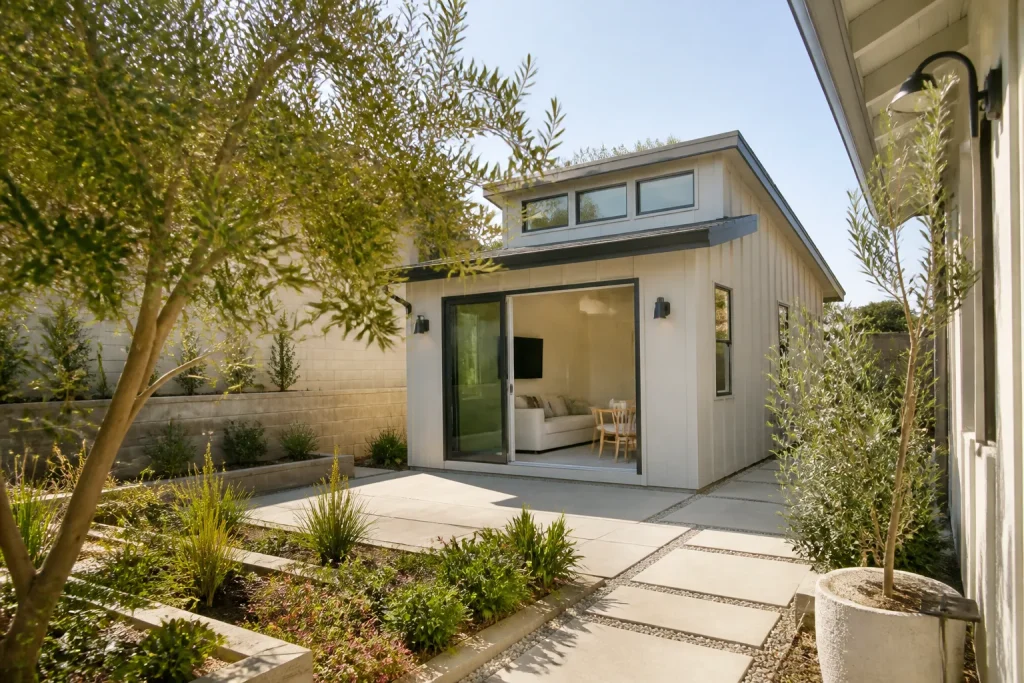
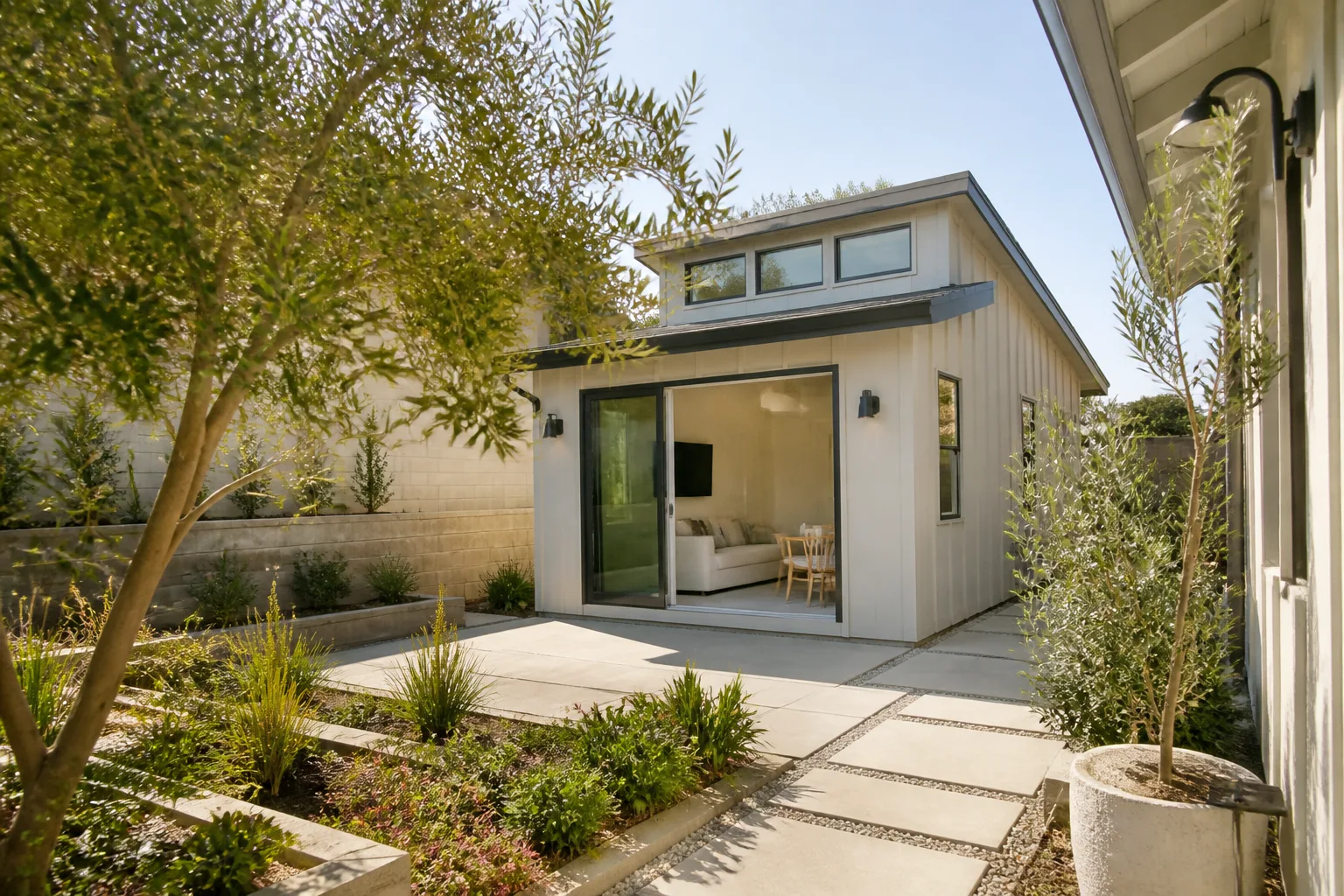
James Hardie ADU Builders in Yorba Linda: A Homeowner’s Guide
Most Yorba Linda homeowners researching an ADU will hear the name James Hardie within the first week. It’s the most common fiber cement siding in Southern California, and for good reason. But the product’s 30-year warranty means nothing if the installer doesn’t follow Hardie’s spec to the letter. If you’re comparing ADU Builders in Yorba Linda, the difference between an exterior that lasts three decades and one that fails in five comes down to about two dozen installation details most contractors never check. If you’d rather not sort through those details yourself, call (877) 752-4191 and we’ll walk you through it.
Why James Hardie Dominates Yorba Linda ADUs
Fiber cement has become the default exterior recommendation in inland Orange County, and Yorba Linda’s climate is exactly why. Our summers push past 90 degrees for weeks at a time. Winters drop into the low 40s at night. That thermal cycling expands and contracts wood siding until it cracks, gaps, and invites moisture. Vinyl fades and warps under direct sun. Hardie’s fiber cement board was formulated precisely for this kind of heat cycle. It doesn’t expand or contract at nearly the same rate as wood or vinyl, and it holds paint longer than either.
Fire is the other factor. Yorba Linda sits in a high and very high fire hazard severity zone, depending on the hillside. Homes and structures in those zones face material requirements that a lot of Orange County flatland cities don’t. Fiber cement is non-combustible, which is why it clears those requirements where wood lap siding often won’t. If your lot backs up to the Chino Hills State Park corridor, that matters. A builder who’s done ten ADUs in the flatlands of north Orange County may not know how Hillside Ordinance setbacks affect your project, and they may not know how the fire zone changes the cladding conversation.
And then there’s the HOA angle. Yorba Linda has more HOA-governed neighborhoods than any city of its size in the county. Architectural committees in places like Vista del Verde and East Lake Village routinely approve fiber cement that is finished to resemble smooth stucco or wood lap, where they’ll reject vinyl and aluminum outright. HardiePanel with a smooth finish and the right trim details often passes where other products stall. If your project is in an HOA, you’ll want a builder who can submit a cladding spec that reads the way the committee expects.
What the Warranty Doesn’t Tell You: Installation Specs That Matter
James Hardie publishes installation requirements down to the fastener type, fastener spacing, and the gap you leave at trim joints. Fail any one of those, and the warranty is void. The homeowner doesn’t get a letter saying so. The failure shows up as swelling at the bottom edge of a panel two wet seasons later, or hairline cracks radiating from a nail that was driven too deep, or trim pulling away because the approved caulk was swapped for whatever was on the shelf at the supply house.
Here are the five details we verify on every Yorba Linda install:
- Fastener type: Hardie requires corrosion-resistant roofing nails or approved screws. Hot-dipped galvanized, not electroplated. In a climate that gets morning marine layer even inland, electroplated nails rust in a few years and bleed orange streaks down the face.
- Fastener spacing: For lap siding over studs, it’s 16 inches on center at minimum. More in high wind exposure areas, which some Yorba Linda ridgelines qualify for.
- Drainage gap: Fiber cement cannot sit directly against the weather-resistive barrier. Hardie’s spec calls for a drainage plane, which on a typical ADU means furring strips or a rainscreen mat. Skip this and trapped moisture has nowhere to go.
- Trim transitions: Hardie approves specific sealants. Most are polyurethane or modified silicone caulks. Acrylic latex painter’s caulk is not on the list, and it’s the one everyone reaches for by habit.
- Joint flashing: Where horizontal panel joints occur, the spec requires Z-flashing. If you see a builder using a bead of caulk at a butt joint, that’s a red flag on the manufacturer’s own check sheet.
None of this work is exotic. It’s just exact. The reason so many James Hardie exteriors underperform in Orange County is not the product. It’s that general crews treat it like wood and cut corners they don’t know count. Our team at Uptown ADU Builders home runs the manufacturer’s current install manual on every Hardie job, and the difference shows at the five-year mark.
Hardie on a Prefab ADU vs. a Site-Built Frame: What Actually Changes
Prefab and modular ADUs arrive on a truck with much of the building already assembled. The exterior cladding, though, is often applied in the field after craning and setting, not in the factory. That sequencing changes where the Hardie panels terminate and how they join.
On a site-built stick frame, you have conventional stud spacing, typically 16 inches on center, and the framing crew worked with the cladding plan from day one. On a prefab from Plant Prefab or Abodu, the wall modules come with their own structural sheathing and often a factory-applied weather barrier. The Hardie install happens afterward. The panel joints land where the modules meet, and those seams are structural. They move when the building settles into its foundation. If the cladding crew doesn’t account for that movement, you get cracks at the module joints that no caulk will keep closed.
A Tuff Shed-based ADU is a different animal again. The shed shell has its own stud layout, which doesn’t always match the 16-inch grid a Hardie crew expects. The substrate is typically a T1-11 or similar wood panel. Fastening fiber cement over that requires adjusting fastener length and layout so every nail bites a structural member. A crew that’s only done standard stick framing will miss studs, and you’ll see rows of fasteners set into void behind the panel. That’s how Hardie pulls loose on a shed conversion.
We pulled a Hardie installation off a shed-conversion ADU over in the Bryant Ranch area a while back where nearly a third of the nails had missed structure entirely. The homeowner had paid for a premium exterior and got a warranty that was already void on day one. The fix required removing every panel, furring out the entire shell, and reinstalling to spec. It cost more than the original cladding contract. If the builder had checked the stud map once before firing the first nail, none of it would have happened.
This is where a builder with real brand familiarity across Abodu, Cover, Dvele, Mighty Buildings, Boxabl, Plant Prefab, and Tuff Shed earns their fee. Not all of these manufacturers have certified installers in every market, and how Hardie goes on varies by module type. A general contractor who has done one prefab project doesn’t have the pattern recognition to spot a sequencing issue before it becomes a warranty problem.
How Cladding Choice Affects Your Yorba Linda Permit
The City of Yorba Linda requires plans that show exterior finish materials and fire-rated assemblies before a building permit is issued. If your ADU falls inside a high fire hazard severity zone or a designated hillside district, the cladding selection is reviewed against both the California Residential Code and the city’s own adopted amendments.
James Hardie products generally simplify that review. Fiber cement is classified as a non-combustible exterior wall covering under the code definitions most commonly cited. That’s not a free pass, but it removes the biggest single objection a plan checker can raise about the exterior. Wood lap siding in a fire zone triggers a different conversation about ignition-resistant assemblies and larger setbacks. Vinyl has its own issues with heat deformation that some plan checkers flag in hillside conditions. Hardie, spec’d correctly, sails through the materials check.
HOA submittals are the step that trips more Yorba Linda ADU projects than city review. Most HOAs in this city have architectural guidelines written for primary residences and applied, sometimes awkwardly, to accessory structures. The committee cares about curb appeal first: color, texture, trim profile, how the ADU reads from the street. If your ADU is visible from a public right-of-way, expect a tougher review than if it’s tucked behind the house. Hardie’s product line covers the usual range: smooth panel, lap, shingle, panel. We’ve seen projects where matching the primary home’s stucco or wood texture was the specific condition of approval.
Here’s what helps: submit your cladding spec as a material board with a manufacturer data sheet attached. James Hardie publishes data sheets for every product line, including fire ratings and fastening requirements. An HOA committee that might reject a one-line description will usually approve a documented spec. If you’re working with an ADU builder, ask whether they’ll prepare that submittal for you. It’s a small piece of the job that makes an outsized difference to the approval timeline.
Related services in Yorba Linda: if your ADU will include a finished bathroom and kitchen, Bathroom Remodeling in Yorba Linda and Kitchen Remodeling in Yorba Linda are done by the same crew that builds the structure. No second contractor, no scheduling gaps.
Eight Questions to Ask a Yorba Linda ADU Builder About James Hardie
You don’t need to memorize the installation manual. You need to find out whether the builder has. The following questions separate crews that install Hardie from contractors who have a Hardie relationship:
- Are you a James Hardie Preferred or Elite Preferred contractor? The brand’s contractor program requires proof of installation training. If the answer is no or a vague “we do Hardie all the time,” ask the next question.
- Do you follow the current installation spec for each product line? Hardie updates its requirements periodically. A builder whose binder is from 2019 is installing to an outdated standard.
- Will you use the fasteners and sealants Hardie approves, by name? If they can’t tell you what fastener they plan to use off the top of their head, that’s your answer.
- How do you handle the drainage plane behind the panel? On a prefab or shed conversion, this answer tells you whether they’ve done this specific installation before.
- How do you detail panel joints at module seams on a factory-built ADU? If they pause, they haven’t done one.
- Who on your crew actually installs the cladding? If it’s the same framing crew that did the foundation, that’s not a cladding specialist. Hardie rewards installers who do it daily.
- Will you provide the James Hardie data sheet with my permit submittal? This is table stakes for a smooth Yorba Linda review.
- What does your Hardie work look like after three or four years? Ask for references from projects completed at least three seasons ago, not a week after closeout.
We don’t expect a homeowner to run these questions down for every trade. That’s what you’re paying a builder to know. But if you’re interviewing three contractors for the same ADU, the difference in how confidently each one answers these eight points will tell you a lot about who’s actually going to protect your investment.
When to Call a Pro
If you’re at the stage of comparing exterior materials for an ADU, you’re well past the point where a professional opinion will save you money. The cladding decision affects structural detailing, fire compliance, HOA submittals, and the interior finish schedule. A mistake here isn’t caught until the first heavy rain, and by then it’s a five-figure fix. We’re happy to look at your lot, talk through whether a site-built, prefab, or Tuff Shed pathway fits, and recommend the Hardie product line that makes sense for your budget and your exposure. Estimates are free.
The Bottom Line
James Hardie is the right exterior for most Yorba Linda ADUs. It handles the inland heat cycle, satisfies fire-zone requirements, and clears HOA reviews that reject lesser products. But the product only performs when the installation follows the manufacturer’s current spec, down to the fastener, the drainage gap, and the caulk at trim transitions. Prefab and shed conversions have sequencing quirks that a general crew won’t catch until it’s too late. Ask your builder the eight questions above. If the answers feel shaky, keep looking. If you’re in Yorba Linda and want a team that works with James Hardie, the major prefab brands, and Tuff Shed conversions under one roof, Uptown ADU Builders offers free estimates. Call (877) 752-4191.
Frequently Asked Questions
Expect installed fiber cement in Orange County to run roughly $14 to $22 per square foot of wall area, depending on product line, trim complexity, and whether the job is a simple lap install or a more detailed panel-and-trim design. For a typical 400 to 800 square foot ADU, the cladding package usually falls between $12,000 and $28,000 installed. Call (877) 752-4191 for an exact line-item quote on your project.
Low maintenance, not zero maintenance. The paint finish on Hardie lasts longer than wood or stucco because the substrate is dimensionally stable. Plan on repainting every 12 to 15 years, versus 5 to 8 for wood in the Yorba Linda sun. The material itself won’t rot, crack, or warp, and it’s resistant to termites, which are a real concern in this part of the county.
Yes, and it usually is installed in the field after the modules are set. The installation sequence differs from a site-built frame because panel joints land at module seams and the structural movement is different. Ask your builder specifically about their experience installing fiber cement on factory-built structures before you sign.
In most cases yes, and it often clears where wood, vinyl, and aluminum stall. HOAs in Yorba Linda tend to approve fiber cement that matches the primary home’s architectural character, whether that’s lap, panel, or shingle. Submitting a material board with the manufacturer data sheet attached measurably improves approval odds. Call (877) 752-4191 and we’ll help you prepare the submittal.
Written by the team at Uptown ADU Builders, serving Yorba Linda since 2018.
Need ADU Help?
Call Uptown ADU Builders — licensed & insured, here with fast after-hours help in Yorba Linda.
(877) 752-4191